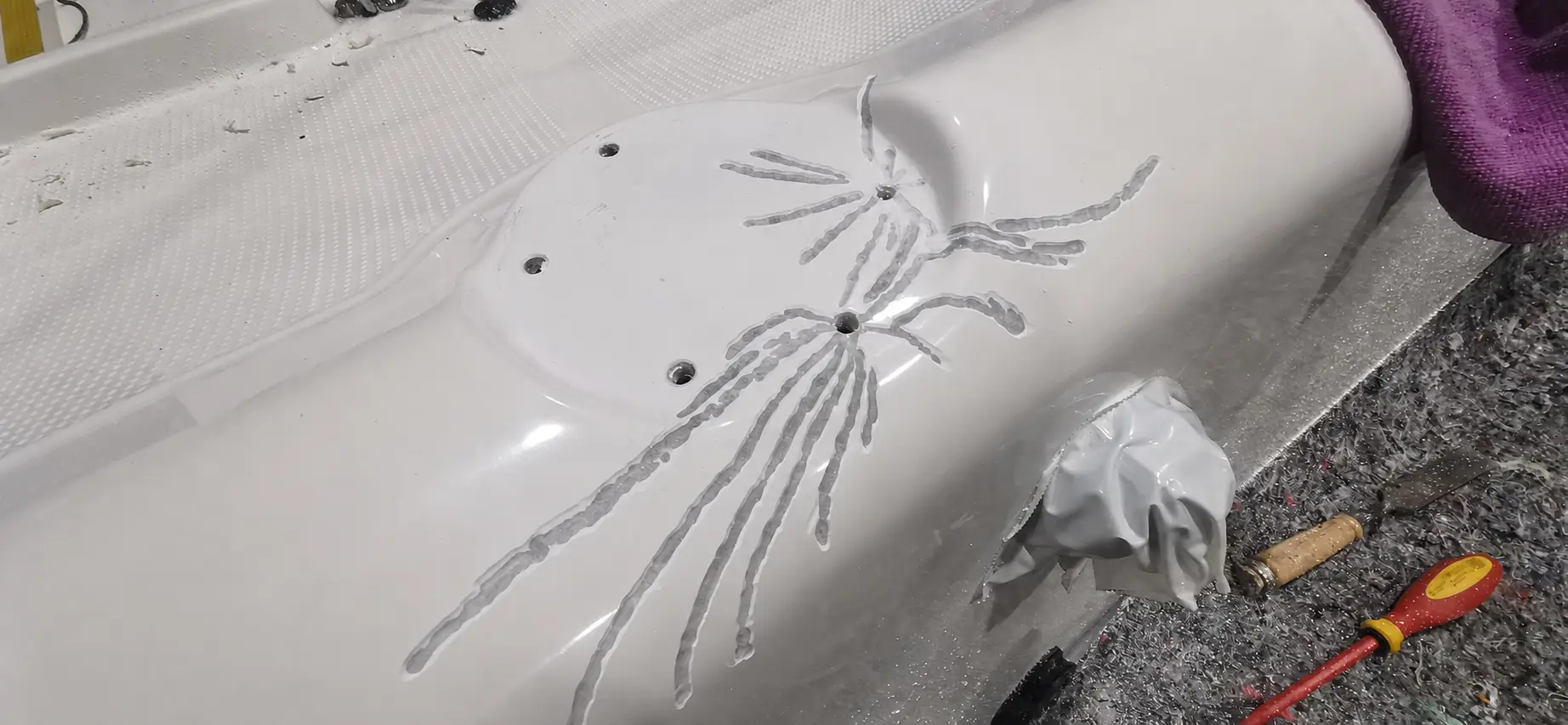
Gelcoat is the visible skin of many GRP boats. It carries colour and gloss, protects the laminate from routine exposure and, because it is comparatively brittle, often becomes the first place where movement or impact leaves a visible trace. A fine line can therefore be nothing more than a finish defect, or it can be the surface expression of a load, void or damaged laminate below. The useful question is not simply “how wide is the crack?” but “why did it appear here, in this shape, at this time?”
Start with location, direction and pattern
Location changes the meaning of a crack. Hairlines around a stanchion base, chainplate, cleat, pulpit foot, deck fitting or hard internal corner deserve more attention than a random surface mark in a lightly loaded panel. Technicians map the defect before sanding anything away: where it starts and stops, whether it follows a moulded radius or a hidden bulkhead, whether several cracks radiate from one fastener, and whether the line continues onto an adjacent surface.
Pattern is equally useful. A single narrow line can come from a local impact or a sharp stress concentration. A group of short parallel lines may indicate repeated flexing. Fine “star” cracks around a point can be consistent with impact or concentrated loading. Crazing spread over a larger area may relate to age, coating thickness, repeated movement or earlier refinishing. None of these patterns proves structural damage by itself, but each one tells the inspector where to look next.
The surface inspection comes before the repair
Good diagnosis begins with the area clean and dry enough to see properly. Lighting is moved across the surface rather than kept directly in front of it because low-angle light makes small changes in contour easier to read. The technician looks for chipped edges, slight depressions, raised ridges, print-through, local dullness and colour differences that can indicate an older repair. The surrounding fittings are checked for movement, distorted bedding or fasteners that no longer sit square.
Gentle pressure and comparison with the surrounding panel can reveal movement that is not obvious visually. Where appropriate, percussion or “tap” sounding can help identify a change in response that may justify further investigation, although its interpretation depends on laminate construction and access. On cored structures, moisture readings may also form part of the assessment, but they are treated as comparative evidence rather than a standalone verdict.
What a genuinely cosmetic repair involves
A cosmetic repair is appropriate only when the defect is confined to the finish and the substrate beneath it is stable. The crack is normally opened enough to remove weak, unsupported edges and to create a repair shape that can be properly prepared. Simply wiping filler over a hairline may make it disappear for a short time while leaving the same movement and weak edge underneath.
Preparation is what determines whether the repair blends or announces itself. The surface has to be cleaned, keyed and feathered without unnecessarily enlarging the work area. Colour matching on aged gelcoat is rarely a matter of using the original factory colour straight from the tin: UV exposure, previous polishing and local ageing change the surrounding shade. The filled repair is then levelled, progressively finished and polished to bring gloss into line with the adjacent surface without creating a visible halo.
When the scope needs to become structural
If the inspection finds substrate movement, a dull or inconsistent sound, moisture evidence, impact distortion or signs that a cored panel has lost support, the cosmetic scope should stop. Access from the reverse side can be especially valuable around deck fittings, bulkhead bonds and local reinforcements because it allows the technician to see whether the visible line corresponds with cracking, debonding or movement underneath.
A structural repair needs its own approved scope. That normally defines access, removal of damaged or poorly bonded material, the laminate or core work required, curing conditions, reinstatement of removed fittings and the final cosmetic finish. The sequence matters because a perfect surface repair applied before the underlying movement is corrected can crack again even though the workmanship on the gelcoat itself was sound.
Before the inspection, note when you first saw the crack and what happened immediately beforehand. A hard passage, grounding, lift-out, rig adjustment, collision with a pontoon, new deck fitting or heavy load can all help identify the load path worth checking first. Photographs taken when the defect first appeared are useful for showing whether it has changed.
Areas that deserve extra context
Cracks around deck hardware are assessed together with the fastening and bedding system. If a fitting has moved, water may have found a path along a fastener or into a cored panel, so resealing the visible crack alone would not address the source. Around chainplates and rigging attachments, movement can be influenced by loads that are transferred far beyond the small area of gelcoat that is visible from deck level.
Transoms, swim platforms, chines and other geometrically stiff areas can also concentrate loads differently from broad flat panels. On older boats, previous repairs matter: a colour change, different fairing profile or unusual laminate thickness can alter what the inspector expects to find. This is why the same-looking hairline in two different places may lead to very different repair scopes.
What should be recorded before work closes
A useful repair record states where the defect was found, what inspection was carried out, whether the substrate was judged stable, what material was removed and how the finish was reinstated. For structural work, photographs before closing the area are particularly valuable because they preserve a record of laminate or core work that will no longer be visible once fairing and gelcoat are complete.
After finishing, the surface should be checked in changing light rather than only under workshop lighting. The owner should understand both what was repaired and what was not found. That distinction is important: “no evidence of deeper damage was found in the inspected area” is a useful technical statement, whereas a broad promise about every hidden part of the structure is not.
Why the distinction matters
A neat surface repair can hide a problem without resolving it if the substrate is still moving. Equally, treating every hairline as structural damage can create unnecessary cost, access work and cosmetic disruption. The purpose of diagnosis is to avoid both extremes. A disciplined inspection establishes whether the visible line is the job itself or only the clue that leads to the real job underneath.